
Hospitals
From charity to specialized care, 1800–2025
By Isabelle Devos
Medical care in Belgium has not always looked the way it does today. In the 19th century, hospitals were mainly charitable institutions caring for the poor and vulnerable. Over the next century and a half, they were transformed into centres of treatment, technology, and specialised medicine, while access to healthcare expanded across the population. How did Belgium move from a scattered network of charitable institutions to the highly organised hospital system we know today?
Image: Jan Baptiste Beerblock, Painting of wards of the St. John’s Hospital in Bruges, 1778.
Until the mid-19th century, hospitals in Belgium were very different from those we know today. Most people were cared for at home by family members or friends, sometimes with help of a doctor or a surgeon (see article on ‘Doctors’). Hospitals were mainly institutions of poor relief rather than places of medical treatment. They provided food, shelter, and basic care to the poor, homeless, and chronically ill. Many dated back to the Middle Ages or early modern period and were run by local authorities, with much of the daily care provided by Catholic nuns or brothers. Doctors played only a limited role.
Conditions were difficult in these institutions, partly because hospitals admitted many of the poorest and most vulnerable patients, and partly because medicine could still do little to treat serious disease. Wards were often overcrowded, and infections spread easily. Common treatments such as bloodletting and purging were often ineffective and could even be harmful. As a result, hospitals were widely regarded not as places of healing, but as places of last resort and often as places where one went to die.
The word hospital comes from the Latin hospitale (meaning inn or guesthouse) and ultimately from hospes, which means guest or stranger. Originally, a hospital or hospice was a place where strangers and pilgrims could stay overnight and find lodging. Over time, these places also began to care for people who were ill.
A fragmented system
Figure 1. Hospitals and distance to the nearest hospital in Belgium, ca. 1850, 1890, 1939, 1970
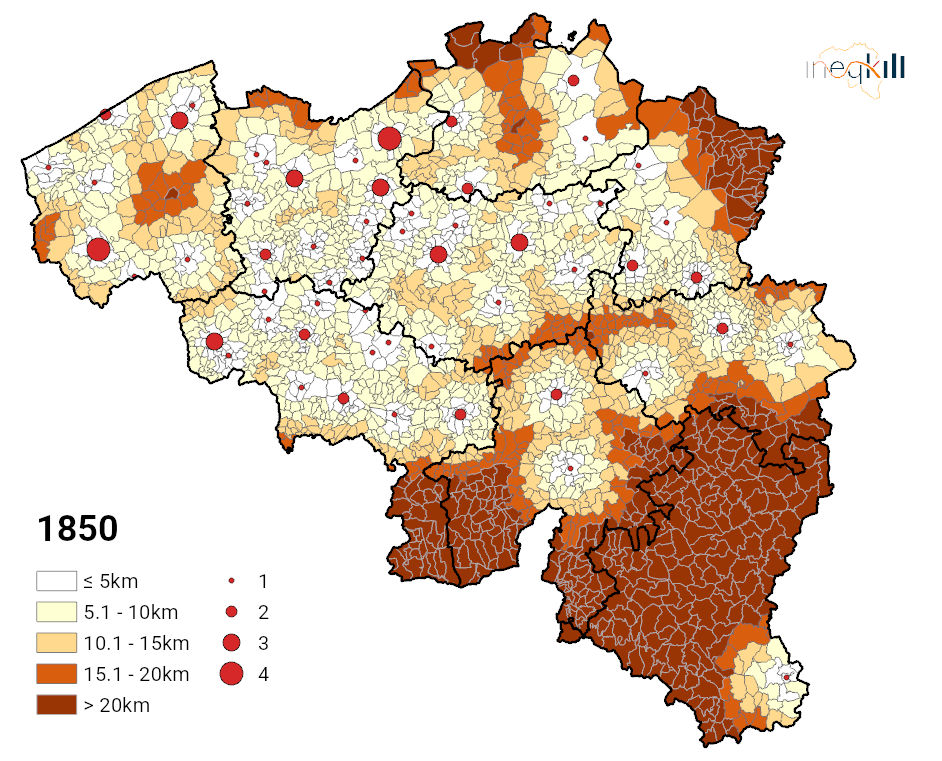


Sources: 1850: Ducpetiaux, Institutions de Bienfaisance de la Belgique, 1852; Exposé décennal sur la situation administrative du Royaume 1841-1850; 1890: Moniteur Belge, 24 April 1890; 1939 and 1970 : Annuaire de la Santé Publique.
Today, Belgium has 103 hospital organisations across 189 locations. Counting hospitals in the 19th century is much more difficult, because many institutions combined medical care with poor relief and other forms of social care. The system was highly fragmented and locally organised. Civil authorities, religious organisations, and private initiatives all ran institutions, while the central government exercised little direct control.
Around 1850, many hospitals still had their roots in medieval or early modern hospices. Hospital care was concentrated in major cities such as Brussels, Antwerp, Ghent, and Liège, but smaller towns and former religious centres including Ypres, Tournai, Zomergem, Zottegem, and Braine-le-Comte also had hospitals. Their presence often reflected older patterns of charity, religious institutions, trade, and travel.
In 1850, Belgium’s hospital network was sparse and unevenly distributed (Figure 1). The map reflects a patchwork of local institutions of which most had their roots in medieval or early modern hospices. Hospital care was concentrated in major cities such as Brussels, Antwerp, Ghent, and Liège, but smaller towns and former religious centres including Ypres, Tournai, Zomergem, Zottegem, and Braine-le-Comte also had hospitals. Their presence often reflected older patterns of charity, religious institutions, trade, and travel. Still, large parts of the countryside, especially in Limburg, Antwerp province, West Flanders, and southern Belgium, had few or no hospitals. For much of the rural population, institutional care therefore remained difficult to access.The contrast was especially striking in southern Belgium, where vast areas of the Ardennes and Luxembourg lay more than 20 kilometres from the nearest hospital.
Medical innovation
Figure 2: Observations of microorganisms, 1873

Hospitals changed dramatically during the second half of the 19th century, as new medical knowledge and technologies transformed what doctors could do. One important breakthrough was the introduction of anaesthesia in the 1840s. Ether and chloroform made it possible to operate without causing extreme pain, allowing surgeons to perform longer and more complex procedures.
Another major change came with germ theory in the late 19th century, which established that many diseases were caused by microorganisms. Together with new ideas about antisepsis, this transformed surgery and hospital hygiene. Doctors and nurses increasingly washed their hands, wounds were cleaned, instruments were sterilised, and greater attention was paid to cleanliness in operating rooms and wards. These measures greatly reduced the risk of infection and helped make hospitals safer places for surgery. Gradually, more surgical procedures moved from patients’ homes into hospitals.
From the mid-19th century onwards, medicine became increasingly specialised. Doctors began focusing on particular diseases or parts of the body and received additional training. New medical disciplines emerged, supported by new professional associations. In Belgium, these included anatomopathology (1857), psychiatry (1869), public health (1889), gynaecology (1889), and surgery (1892), among others. Hospitals became important centres of this growing specialisation, as well as of medical training and research. Laboratories, microscopes, chemical tests, and new diagnostic instruments became part of medical education. Universities in Leuven, Ghent, Brussels, and Liège expanded their facilities to support this more scientific approach.
After 1880, hospitals increasingly added operating rooms and laboratories and adopted new principles of hygiene and hospital design. Specialised institutions, including maternity and children’s hospitals, also became more common. By the end of the century, hospitals were becoming centres of treatment, training, and medical innovation.
Yet for much of the population, especially in rural areas, the local doctor remained the main source of medical care, treating a wide range of illnesses. By 1890, the hospital network had expanded considerably, particularly in northern Belgium, where hospitals were increasingly found in smaller towns as well as major cities (Figure 1). Regional inequalities nevertheless remained substantial. Parts of southern and south-eastern Belgium had few hospitals and physicians (see article on ‘Doctors’). Large parts of the Ardennes and Luxembourg province were still more than 20 kilometres from the nearest hospital, revealing a persistent regional north-south in access to medical care.
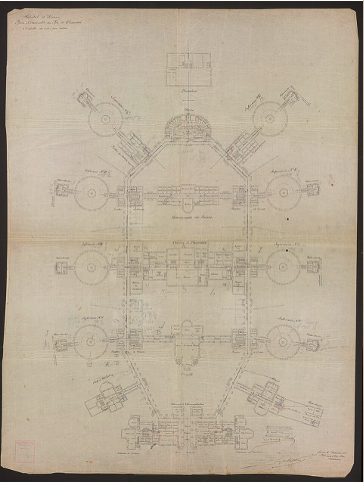
Figure 3: Floor plan of the Stuivenberg Hospital in Antwerp, 1884
Toward better access
Figure 4: Operation room, Bijloke hospital Ghent, 1950s

The early 20th century marked the start of a more structured hospital network across the country. Brussels and central Belgium developed into major hospital hubs, while cities such as Ghent, Liège, and Antwerp strengthened their regional roles.
By 1939, hospital care had expanded significantly, reducing some regional inequalities (Figure 1). This reflected growing public involvement in healthcare, marked by the creation of Belgium’s first Ministry of Public Health in 1936. Mutual health insurance funds also helped make medical care accessible to a larger share of the population. At the same time, medicine became increasingly specialised, with more trained professionals working in hospitals, universities, and public health institutions. Yet peripheral regions such as the Ardennes and parts of Limburg and Luxembourg continued to lag behind (Figure 3a).
After the Second World War, Belgium’s medical infrastructure expanded rapidly. The growth of the welfare state and compulsory health insurance made medical and hospital care affordable to a much larger share of the population. Hospitals also entered a new era. Technologies such as X-rays became widely available, while antibiotics, improved laboratory testing, and new monitoring equipment transformed diagnosis and treatment. Medical care became increasingly specialised and team-based, with doctors, nurses, and other specialists working together. Family doctors remained the first point of contact, referring patients to hospitals when more specialised care was needed.
By 1970, Belgium had a dense hospital network, with 458 hospitals (Figure 1). Many people lived within five kilometres of a hospital, and most within 10 kilometres, although gaps remained in some rural areas of the Ardennes, Limburg, and West Flanders. Meanwhile, major cities developed concentrations of larger and increasingly specialised hospitals.
Increasing specialisation and integration
From the 1980s onwards, medicine became even more specialised, with many disciplines dividing into subspecialties. Cardiology, for example, expanded into fields such as interventional cardiology, cardiac imaging, and heart rhythm disorders. Patients were also increasingly treated by multidisciplinary teams rather than by a single specialist. Hospitals also began using more advanced technology, such as scanners. But these advances also made healthcare more expensive.
In recent decades, Belgian healthcare policy has therefore placed greater emphasis on coordination. General practitioners, specialists, hospitals, and other care providers increasingly work together, supported by digital tools and shared electronic health records. Hospital mergers and the concentration of specialised services have reduced the number of separate hospital organisations and sites. The aim is to combine highly specialised hospital care with better coordination across different levels of healthcare.
TODAY, Belgium has seven university hospitals that combine specialized care with academic research and medical education:
- UZ Leuven,
- UZ Gent,
- UZ Antwerpen,
- UZ Brussel,
- Hôpital Erasme,
- CHU de Liège, and
- Cliniques universitaires Saint-Luc.
Their histories reflect the changing hospital landscape. Some, such as UZ Leuven and UZ Gent, have roots in much older institutions, while others were established mainly during the expansion of academic medicine in the second half of the 20th century. Together, they form the core of Belgium’s academic hospital network.
Read more?
- Jan De Maeyer, Lieve Dhaene, Gilbert Hertcant en Karel Velle (red.), Er is leven voor de dood. Tweehonderd jaar gezondheidszorg in Vlaanderen, Kapellen: Pelckmans, 1998.
- Norbert Fraeyman, Frank Cotman, André De Schaepdryver, UZ50 : 50 jaar UZ Gent, UZ Gent, 2009.
- Robrecht Van Hee, Het Stuivenbergziekenhuis (1879-2022), een erfgoedicoon in Antwerpen,2022.
- Joris Vandendriessche, Zorg en wetenschap. Een geschiedenis van de Leuvense academische ziekenhuizen in de twintigste eeuw. Universitaire Pers Leuven 2019.
Data sources
- Annuaire médical de la Belgique, 1861.
- Annuaire statistique de la Belgique, 1870-1994.
- Annuaire de la Santé publique, 1939-1970.
- Documents statistiques de la Belgique, 1857-1867.
- Ducpétiaux, E. Institutions de bienfaisance de la Belgique, 1852.
- Exposé de la situation du royaume de Belgique, 1851-1900.