
Malaria
By Sophie Van Wambeke
When we think of malaria today, we tend to think of tropical regions, mosquito nets and children suffering from dangerous fevers. There is good reason for this association: today, the overwhelming majority of malaria cases and deaths occur in Africa. Children under the age of 5 are particularly vulnerable.
But malaria was not always confined to the tropics. Until well into the 19th century, the disease was also widespread across Europe, reaching as far north as Scandinavia. Belgium was no exception. From the Middle Ages until the late 19th century, malaria was a familiar disease in parts of the country, particularly in marshy and low-lying areas.
What is malaria?
What is malaria?
Malaria is an infectious disease caused by Plasmodium parasites and transmitted to humans through the bites of infected Anopheles mosquitoes. It causes high fever, chills, headaches and muscle aches. Without treatment, it may lead to organ failure and death.
Where does it occur?
Today, malaria occurs mainly in tropical and subtropical regions, particularly in sub-Saharan Africa. In the past, however, it was also widespread across Europe. The disease was endemic in marshes, wetlands and other breeding grounds for Anopheles mosquitoes.
Diagnosis and treatment
Malaria is diagnosed by detecting the parasite in the blood. Today, it is treated with antimalarial drugs, often artemisinin-based, although drug resistance is rising. Quinine, once the standard treatment, is now used much less frequently.
Prevention and control
Malaria can be prevented by reducing contact with mosquitoes using bed nets and repellents. A vaccine is only available since 2021 and reserved for children in Africa. Travellers to malaria-endemic regions must rely on antimalarial pills.

A disease hidden behind other names
Tracing malaria in historical records on Belgium is not always straightforward. 19th-century doctors generally recorded the disease as intermittent fever (in French fièvre intermittente, and in Dutch wisselkoorts or anderendaagse koorts). These names reflect one of malaria’s most distinctive symptoms, recurring attacks of fever.
Malaria is caused by Plasmodium parasites transmitted by Anopheles mosquitoes. In north-western Europe, the most common form was Plasmodium vivax, which typically causes fever attacks at intervals of about 48 hours. Unlike much deadlier P. falciparum, responsible for most malaria deaths in Africa today, P. vivax is less likely to kill directly. Repeated infections, however, can cause anaemia, exhaustion and greater vulnerability to other diseases, debilitating effects that were already recognised by contemporaries since early modern times.
Historical death records therefore capture only part of malaria’s true impact. Many people suffered repeatedly from the disease without malaria ever appearing as their official cause of death.
The Mouvement de la Population allows us to trace the geography of recorded malaria mortality in Belgium from 1886 onwards, when the disease was already in decline. Around 200 deaths were attributed to malaria that year. Their number fell rapidly over the following decades, and by the 1930s malaria deaths had become rare.
Figure 1: Total number of malaria deaths per province, per decade
Source: State Archives Brussels, Mouvement de la population, 1886-1950; calculations by the author.
Marsh fever
Figure 2: Number of malaria deaths per location, 1889-1950
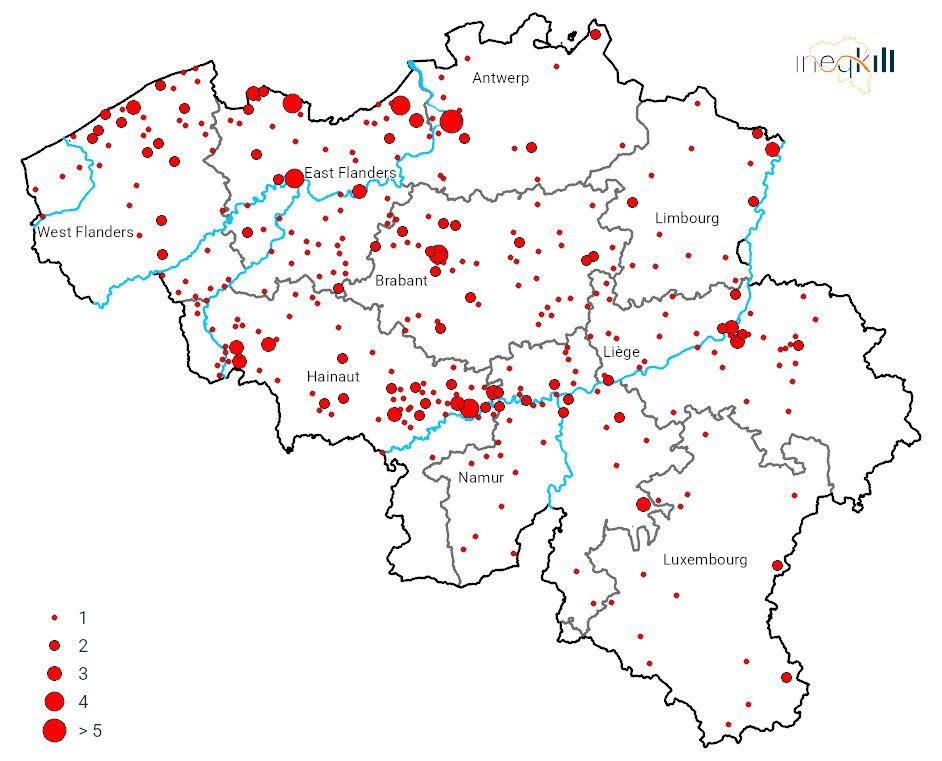
This national decline concealed striking regional differences. We mapped malaria deaths by municipality between 1889 and 1950. The map in figure 2 reveals a highly uneven geography: many municipalities recorded only occasional deaths, while others formed clear clusters of higher mortality. This pattern can be mainly explained by the ecology of the mosquito that transmitted the parasite.
In north-western Europe, Anopheles atroparvus was an important vector of Plasmodium vivax. It flourished in wet environments, including brackish and stagnant water. Malaria was therefore particularly associated with coastal areas, polders, river valleys and marshlands. Historical names such as marsh fever, polder fever and fièvre paludéenne reflect this close connection with the landscape.
Human intervention could inadvertently create favourable conditions for mosquitoes. From the Middle Ages onwards, people constructed dikes, canals and drainage systems to reclaim land and control flooding. Pools and ditches with slowly moving or stagnant water provided suitable breeding grounds. Malaria consequently became endemic in many coastal areas around the North Sea between 1500 and 1750.
Numerous historical accounts in the country describe diseases with malaria-like symptoms, especially along the coast and, to a lesser extent, near rivers and marshlands further inland. Mortality in these areas could be almost twice as high as elsewhere in rural Belgium, although malaria was only one of several factors behind this excess mortality.
Who was most affected?
Figure 3: Number of malaria deaths per age group per year
Source: State Archives Brussels, Mouvement de la population, 1890-1950.
The age profile of recorded malaria deaths also changed over time. In the late 19th century, as figure 3 shows, adults accounted for a relatively large share of deaths attributed to malaria, whereas children became more prominent among recorded victims during the early 20th century.
The reasons for this shift are difficult to establish from death records alone. Exposure, acquired immunity and mobility may all have played a role. Historical accounts suggest that inhabitants of malaria-affected polders developed a degree of acquired immunity, while newcomers from inland areas were particularly vulnerable. For instance, seasonal labourers who travelled to work on large polder farms were so likely to develop marsh fever that their labour contracts allowed for two weeks of illness without dismissal.
At the same time, the changing age pattern may partly reflect the broader mortality transition. In the 19th century, children faced very high mortality from many other infectious diseases, including measles, whooping cough and diarrhoeal diseases. As deaths from these causes declined, malaria may have become more visible in the mortality profile of children. Death statistics alone cannot distinguish between these explanations.
From "bad air" to mosquitoes
Malaria today
Today, the disease remains a global problem, partly because of because of lack of access to prevention, diagnosis and effective treatment. In 2024, the World Health Organization estimated that there were 282 million cases of malaria worldwide. In Belgium, the main concern is imported malaria. Around 400 to 500 cases are recorded each year, mostly among travellers who contracted the disease in Africa.
In a highly unusual case in 2020, however, an elderly couple in Kampenhout in Flemish Brabant died after contracting malaria in Belgium. It is thought that an infected mosquito may have entered the country and their home via Brussels Airport. A recent Belgian survey found that Anopheles atroparvus, once an important malaria vector, has disappeared, although other Anopheles species capable of transmitting the malaria parasite are still present in the country.
Until the late 19th century, doctors did not know what caused malaria. The name itself reflects an older explanation: mal aria, Italian for “bad air”. According to the prevailing miasma theory, malaria and other diseases were caused by unhealthy vapours rising from marshes, pools and stagnant waterways.
The theory was wrong, but some of the measures it inspired had the right effect. During the 19th century, marshes were gradually drained, ditches filled in and water management improved, unintentionally reducing breeding grounds for malaria-carrying mosquitoes. Housing also improved, while changes in the way people kept livestock may have reduced human exposure to mosquitoes.
Meanwhile, scientists uncovered the real cause of the disease. In 1880, the French physician Alphonse Laveran identified the Plasmodium parasite. In the late 1890s, Ronald Ross and Giovanni Battista Grassi and his colleagues demonstrated the crucial role of mosquitoes in malaria transmission. These discoveries fundamentally changed the understanding and prevention of the disease.
By the mid-20th century, malaria had virtually disappeared from Belgium. This happened largely before the powerful insecticide DDT came into widespread use, suggesting that environmental and social changes, such as improved water management, changing land use and better housing, played an important role in its decline. In 1963, Belgium was officially declared malaria-free.
Our publications
- Devos, I. (2001). Malaria in Vlaanderen tijdens de 18e en 19e eeuw. In Parmentier J. et al. (ed.). Orbis in orbem: liber amicorum John Everaert. Gent: Academia Press, 197-233.
Read more
- Devos, I. (2001). Malaria in Vlaanderen tijdens de 18e en 19e eeuw. In Parmentier J. et al. (ed.). Orbis in orbem: liber amicorum John Everaert. Gent: Academia Press, 197-233.
- Knols B. (2009). Mug: de fascinerende wereld van volksvijand nummer 1. Amsterdam: Nieuw Amsterdam Uitgevers.
- Knottnerus, O. (2002). Malaria around the North Sea: a survey. In Wefer, G. et (eds.). Climate development and history of the North Atlantic realm. Berlin: Springer-Verlag, 339-353.
Data sources
-
State Archives Brussels, Mouvement de la population et de l’état civil, 1886-1950.