
Measles
Once a deadly disease, now preventable
By Tom Hacha
Measles might seem like a disease from the past, but recent outbreaks in Belgium tell a different story. Cases are now resurfacing mainly in major cities such as Brussels and Antwerp. A look at Belgium’s history of measles mortality, responsible for over 173,000 deaths between 1851 and 2025, helps explain why vaccination remains crucial today.
What Is Measles?
What is cardiovascular disease?
Cardiovascular disease is a group of disorders affecting the heart and blood vessels, including coronary artery disease, heart attacks, strokes, and conditions related to poor circulation.
Who does it affect?
It affects people of all ages and genders, but the risk is higher in older adults, smokers, inactive individuals, and those with diabetes, obesity, or family history of heart disease.
Diagnosis and Treatment
Diagnosis today includes physical exams, blood tests, ECGs, imaging, and stress tests. Treatment depends on the type and severity of the condition and involves lifestyle changes, medications, or surgery.
Prevention and Control
Prevention and control include healthy diet, regular exercise, avoiding tobacco, managing stress, controlling blood pressure and cholesterol, maintaining healthy weight, and following medical advice.

Brief history
Figure 1:

Measles is one of the oldest human diseases. Scientists estimate that measles diverged from a cattle virus, rinderpest, and became a human disease around the 6th century BCE. However, for much of history, it was confused with diseases with similar symptoms, particularly the appearance of small spots, such as smallpox, varicella, scarlet fever, and rubella. For instance, measles does not appear in the classical antiquity writings because it was not yet recognised as a separate disease. One of the first descriptions dates to the 10th century by the Persian physician Rhazes who published The Book of Smallpox and Measles.
In the Middle Ages, measles was likely widespread across Europe and South and East Asia, alongside the growth of cities that facilitated the sustained circulation of the disease. In Europe, several epidemics were reported in the 11th and 12th centuries. The disease was known as morbilli (“little disease”), from the Latin morbus (“disease”). Later, the English term measles was introduced, and most likely derives from the Middle Dutch (maseln or masel-sucht, meaning “small spots”) or Middle High German (maal and masern). The term rougeole simply refers to the red colour of the rash (rouge).
From the early modern period onwards, measles spread globally through trade and colonial expansion, causing devastating epidemics in previously unexposed populations, sometimes killing up to half or even two-thirds of local populations. Large epidemic outbreaks in England and Scotland in the 17th century provided the conditions for the English physician Thomas Sydenham to produce the first modern clinical description of measles, distinguishing it from smallpox and scarlet fever. In the 19th century, measles was further identified as a disease distinct from rubella (Latin for “little red”).
By analogy with smallpox, attempts were made in the 18th century to prevent measles through inoculation, but the procedure was difficult and never widely adopted. As a result, effective means of preventing remained absent, and relied largely on isolating the sick and removing susceptible individuals from the source of contagion, protecting them from “winds coming from places where the epidemic prevails”.
Figure 2:
Source:
Measles was first shown to be caused by a virus in 1911 by the American physicians Anderson and Goldberger, but it took almost half a century before the virus was identified in 1954 by Thomas Peebles and John Enders. This led to the rapid development of a vaccine. The first measles vaccine was licensed in the United States in 1963, followed by an improved and safer version in 1968 that forms the basis of today’s vaccines. In 1971, it was combined into the MMR vaccine (measles, mumps, rubella) for broader protection. This was later extended to a two-dose vaccination schedule to also protect young children and those for whom the first vaccination failed (around 5%). Since then, vaccination coverage has increased globally, with 84% of one-year-olds receiving the first dose of the measles vaccine in 2024. It is estimated that vaccination has saved over 90 million lives since the 1970s. In 2016, the global measles death toll fell below 100,000 for the first time.
In Belgium, vaccination became available in 1974, although widespread uptake only followed the introduction of the measles-mumps-rubella (MMR) vaccine into the free national vaccination programme for children aged 12 months in 1985. A second dose was introduced in 1995 for children aged 1012 years. In 2019, the Superior Health Council of Belgium advised lowering the age for the second dose. Since the 2020-2021 school year, the age has been lowered to 7-8 years in the French-speaking Community, and since 2025 to 24 months in Flanders.
Figure 3:

Source:
Trends over Time
Figure 4: Measles Mortality Rate in Belgium, 1851 - 2025
Source: Mouvement de la Population et de l’État Civil
Since 1851, measles deaths in Belgium have been continuously recorded, allowing us to trace measles mortality over the past 175 years (see Graph 1). Between 1851 and 2025, a total of 173,381 people died from measles. In the mid-19th century, mortality fluctuated around 25 deaths per 100,000 inhabitants but rose sharply in the late 1860s, exceeding 65 per 100,000. Mortality peaked in 1872 with a crude death rate of 89 per 100,000 inhabitants, corresponding to over 4,600 deaths. After this peak, mortality steadily declined, except during the epidemic of 1889-1893, when rates again fluctuated around 70 per 100,000 inhabitants.
Unlike smallpox and cholera, measles was not subject to preventive measures for most of the 19th century. It was widely regarded as a harmless and inevitable childhood illness. Since 1818, local authorities had to report outbreaks to medical commissions responsible for disease surveillance, but their ability to respond was limited. In the last quarter of the 19th century, concerns grew about the impact of expanding schooling and the establishment of the first crèches, both seen as centres of contagion. Additionally, physicians expressed their frustration with the widespread practice of deliberately exposing healthy children to infection, based on the belief that early contagion was beneficial, while ignoring the fact that poor nutrition could worsen the disease and lead to severe complications. Medical care was often not sought until it was too late, as the disease was considered harmless.
Figure 5: Image in remark
Source:
It was only in 1890 that the Belgian government provided municipalities with clear first instructions. These guidelines prescribed the isolation of the sick or the removal of healthy individuals, the disinfection of rooms, bedding, and clothing, and the temporary exclusion of infected children from school, who could only return three weeks after the onset of symptoms and after taking a soap bath. In severe outbreaks, siblings were also excluded for the same period.
Measles in World War I
Although national data are unavailable for the First World War, measles mortality likely increased again during World War I. During the winter of 1916-1917, newspapers reported epidemic outbreaks in multiple municipalities. These outbreaks were likely driven by severe wartime conditions, including food shortages (sometimes referred to as the Belgian “hunger winter”) and exceptionally cold weather, with February and March the coldest on record for those months in the 20th century.
Add Your Heading Text Here

In Antwerp alone, 111 children died from measles in less than three months, and in several other municipalities, including Brussels, Borgerhout, Tessenderlo, and Seraing, schools were temporarily closed to contain the epidemic. Measles was also widespread in camps for Belgian refugees in the Netherlands, where precarious conditions led to large outbreaks and numerous deaths.
Add Your Heading Text Here

Separate hospital barracks for children with measles (“mazelenbarakken”) in Belgian refugee camps in the Netherlands during World War I, in Uden (left) and Ede (right). (Sources: Belgian State Archives, Pavillon pour les réfugiés atteints de rougeole (Mazelenbarak), I 646, 728 (left); Belgian State Archives, Hôpital pour maladies contagieuses (rougeole), I 646, 635 (right).)
After the First World War, measles mortality continued to decline, reaching zero deaths for the first time in 1986 and the last recorded death in 2004. Importantly, this decline began well before the introduction of vaccination and is often attributed to improvements in living conditions, such as reduced overcrowding and better nutrition. Preventive measures such as isolation and disinfection, introduced from the late 19th century onwards, likely had little effect on measles mortality, as they did not reduce incidence and most children contracted the disease at some point. From the 1930s and 1940s onwards, medicines such as sulphonamides and antibiotics further reduced deaths from complications.
While better living conditions and medical care had greatly reduced mortality, these improvements did little to stop the virus from spreading. Measles incidence only began to decline after the introduction of vaccination, particularly with the introduction of the MMR vaccine in 1985. Following this, the annual number of cases dropped rapidly, from around 81,000 in 1989 to just 83 in 2001. These developments raised hopes that measles could be eliminated, and in 2003 Belgium set the goal of achieving this by 2015. This goal was reached in 2020, when the WHO Regional Verification Commission certified the elimination of measles in Belgium. However, this status remains fragile, as declining vaccination coverage in some areas threatens renewed transmission and overall coverage remains below the 95% needed to prevent circulation. In 2024, first-dose coverage reached 96%, but coverage for the second dose remained much lower, at 82%.
Geographical Patterns
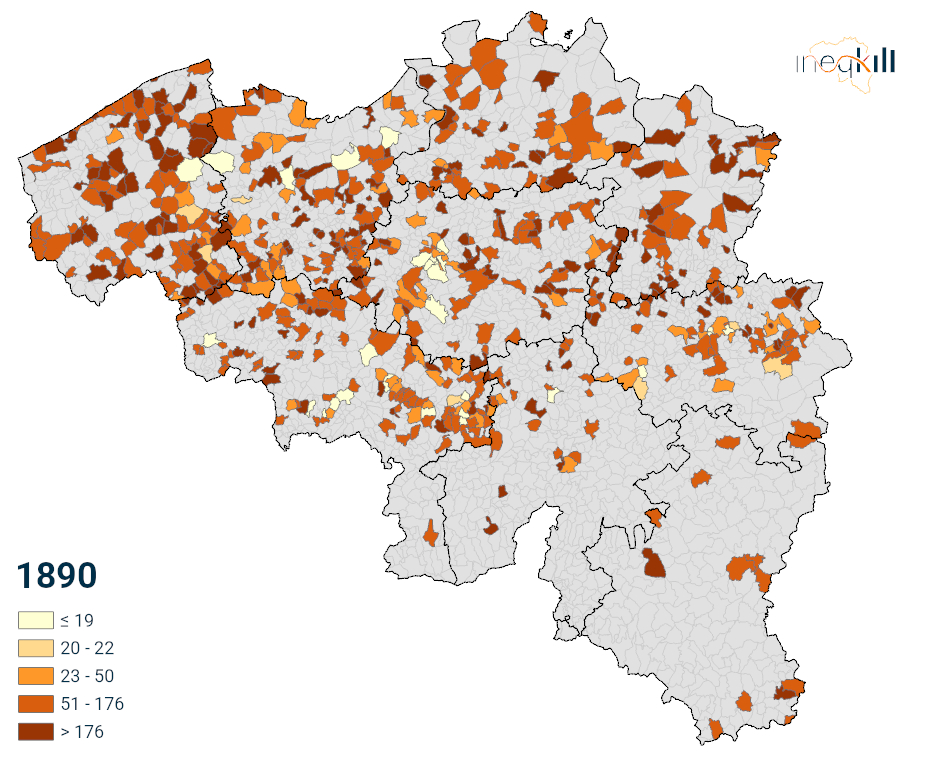
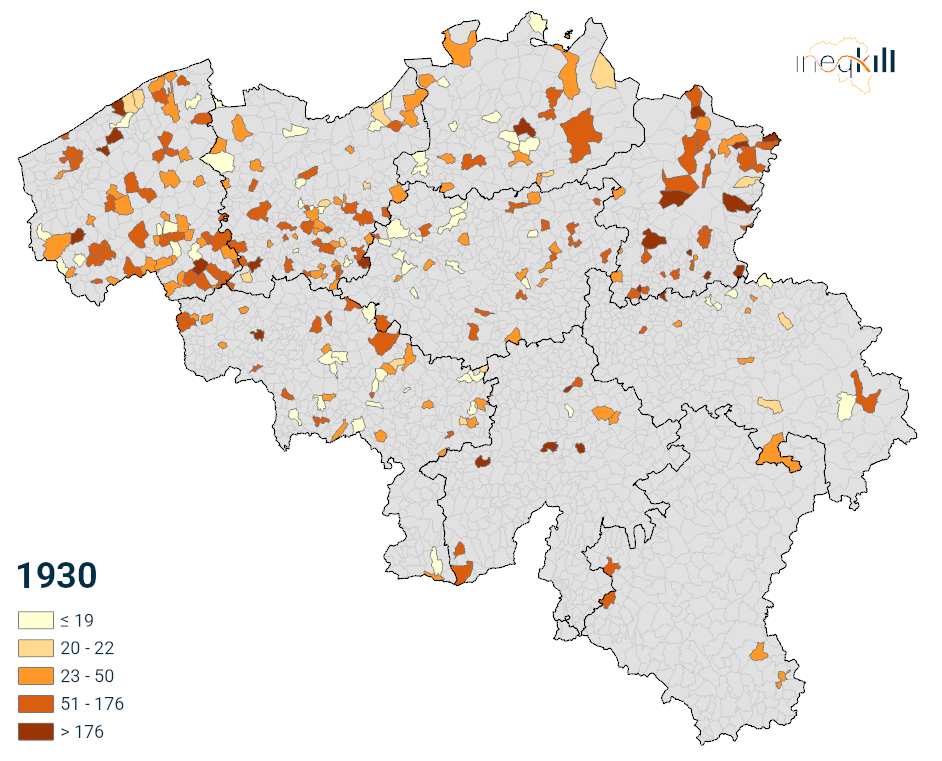
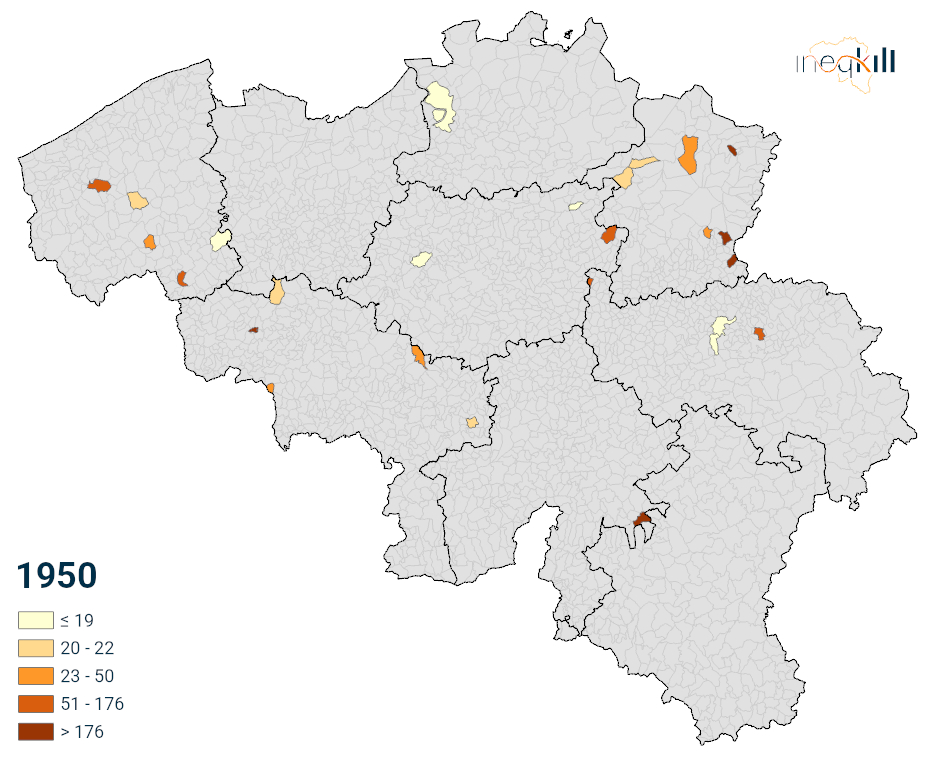
Figure 6: . Municipal crude death rate from measles (per 100,000 inhabitants), Belgium, 1890
Source:
Mapping Belgian municipal data shows how measles mortality declined over time and varied across the country. For example, in 1890, during a large epidemic, 27% municipalities reported measles deaths, but this number fell sharply by 1950, with deaths recorded in only 26 municipalities.
These maps also highlight that mortality was higher in urban areas, where population density facilitated transmission, and more widespread in Flanders than in Wallonia.
This was particularly the case in West and East Flanders, where 52% and 41% of municipalities were affected in 1890. This reflects historical differences in living standards between the north and south of the country.
Measles is more dangerous for malnourished children, and poverty was widespread in Flanders in the 19th and early 20th centuries,”. While Wallonia experienced economic growth, large parts of Flanders remained poor well into the 20th century following the collapse of the rural linen industry in the ….
Who Died of Measles?
Figure 7: probability of dying from measles before age 5
Source: Ghent University Quetelet Center, S.O.S. Antwerpen Database
Studies show that, in the pre-vaccine era, almost everyone contracted measles before the age of 10 to 15, except in more remote areas.
In Antwerp between 1820 and 1946, around 96% of measles deaths occurred among children under the age of 5, highlighting the widespread nature of the disease. Individual-level cause-of-death data from Antwerp offer a more detailed picture of these young victims.
In total, 5,559 children born in the city between 1820 and 1923 died from measles before reaching age 5, corresponding to just over one in every hundred children. There were no differences between boys and girls.
Measles mortality was strongly concentrated in the second and third year of life, as shown in figure 7. Infants were relatively protected during their first months of life by maternal antibodies, but this protection faded quickly. From around 6 months onward, the risk of dying rose sharply, reaching about 0.75% by age 2. After that, the increase slowed and began to level off from around age 3 onwards, reaching approximately 1.1% by age 5.
Figure 8: Probability of dying from measles by social class among children (<5 years) born in Antwerp, 1820-1923

Each point represents children born in that decade and followed up until age 5. Values below 1 indicate lower mortality than the lower class, while values above 1 indicate higher mortality.
Source: Ghent University Quetelet Center, S.O.S. Antwerpen Database.
In addition to age, measles mortality also varied strongly by social class, a phenomenon already noted by contemporary physicians. They observed higher measles mortality among the lower classes and attributed this to parental neglect, arguing that working-class families and the ‘petite bourgeoisie’ (lower middle class) often delayed seeking medical help until death was imminent, due to the widespread belief that measles did not require treatment. Figure 9 shows the risk of dying from measles for children born in each decade between 1820 and 1923, taking into account mortality from other causes. It shows that children from lower-class families consistently faced higher risks than those from more privileged backgrounds. Over time, these differences became more pronounced, likely reflecting the fact that improvements in living conditions, nutrition, and medical care benefited the upper class earlier and more. Whereas the gap between the lower and middle classes was initially relatively modest, it had widened considerably by the early twentieth century. For children born in the most recent decades, the risk among middle-class children fell to less than half that of lower-class children. The gap was even larger for the upper class: already in the mid-nineteenth century, upper-class children faced about 50% lower risks than those from lower-class families, and by the 1920s their risk had fallen to around one-fifth of that of lower-class children.
Why Vaccination Still Matters Today
Compared to historical patterns, measles infections in Belgium remain low today. Between 1989 and 2025, the number of cases declined sharply from 81,044 to just 387. However, this does not mean that vaccination is no longer important. Although death from measles has become rare, the disease remains serious and often requires hospitalisation, with complications such as encephalitis, meningitis, or pneumonia. In 2023, for example, 24 of the 67 reported cases required hospital care. Increasing measles incidence therefore places additional pressure on the healthcare system. Moreover, vaccination remains crucial because measles causes “immune amnesia,” erasing immune memory from previous infections and vaccinations for years and thereby increasing susceptibility to a wide range of infectious diseases well beyond the initial measles illness. Vaccination is therefore also associated with reduced mortality from non-measles infectious diseases. Preventing measles transmission requires high vaccination coverage. The virus continues to spread among people who are not protected, including those for whom the vaccine is ineffective (around 5%), as well as unvaccinated groups such as children under 12 months, who are too young to be vaccinated. To prevent outbreaks, at least 95% of the population needs to be vaccinated to achieve herd immunity, whereby vaccination not only protects individuals but also others
In the nineteenth and early twentieth centuries, measles caused high mortality in Belgium. Data from Antwerp show that mortality was unevenly distributed, with the highest risks in early childhood and among lower social classes. Mortality declined during the 20th century due to improved living conditions, well before the introduction of vaccination in 1974. However, incidence rates only declined after the introduction of the first dose of the MMR vaccine in 1985. Today, dying of measles is extremely rare in Belgium, but the disease remains dangerous due to its complications. Vaccination remains essential to achieve herd immunity, protecting not only vaccinated individuals but also vulnerable unvaccinated groups, such as infants.
Our Publications
Do you want to know more about research on measles in Belgium? You can explore our published articles below:
Hacha, T., & Devos, I. (2025)(Under review at Journal of Interdisciplinary History). Smallpox, measles and other infectious diseases in a growing port city: The evolution of cause-specific child mortality in Antwerp (1820–1946).
Literature
Berche, P. (2022). History of measles. La Presse Médicale (1983), 51(3), Article 104149. https://doi.org/10.1016/j.lpm.2022.104149
Peltola, H. (2025). The History of Measles and Vaccine Development. ACTA PAEDIATRICA. https://doi.org/10.1111/apa.70370
Mackenbach, J. P. (2020). A history of population health : rise and fall of disease in Europe. Brill.
Sources
The Ineqkill Atlas of Mortality Inequalities in Belgium provides detailed information about mortality and diseases in Belgium from 1820 to 2025.
About
- Ineqkill Research Project
- Mission Statement
- Team
- FAQ's
Vrije Universiteit Brussel
Pleinlaan 5 (Room 2.17)
1050 Brussels, Belgium
e-mail: sylvie.gadeyne@vub.be


