
Dementia
The rise of a leading cause of death and its unequal toll on women
By Janna Dinneweth
Imagine being 51 years old, gradually losing your grip on reality. Your memory begins to fail, language slips away, familiar faces become unrecognisable, and daily routines unravel into confusion…
Such was the experience of Auguste Deter, who, in 1901, was admitted to a mental institution in Frankfurt. Her unusual symptoms captured the attention of Alois Alzheimer, a young psychiatrist and neurologist. So began the search into the causes of dementia and what is now known as Alzheimer’s disease.
In Belgium, as in many high-income countries, dementia has emerged over the past decades as a leading cause of death, particularly among older women. Follow along and discover how scientific advances accompanied a growing awareness of the disease and an increasing number of patients.
Image: Brain Model, Early 20th Century, Photo by David Matos (©Unsplash)
What is dementia?
What is Dementia
Dementia is a syndrome of cognitive decline, affecting memory, reasoning, language, and daily activities. It results from neurodegenerative diseases like Alzheimer’s.
Where Does Dementia occur?
Dementia primarily affects older adults, making it more prevalent in high-income countries with ageing populations. The global burden is increasing.
Diagnosis and Treatment
Diagnosis is based on clinical assessment, with neuroimaging improving accuracy. There is no cure, so treatment focuses on symptom management and support.
Prevention and Control
While incurable, modifiable risk factors like hypertension and inactivity are linked to increased risk. Public health efforts increasingly focus on prevention.

The first known case of Alzheimer’s disease
After Auguste Deter (Figure 1) died in 1906, Alois Alzheimer conducted a post-mortem examination, identifying hallmark abnormalities in her brain (amyloid plaques and neurofibrillary tangles) that would later define the condition bearing his name.
Although descriptions of dementia date back to antiquity, Alzheimer’s observations in the early twentieth century marked the beginning of its modern medical conceptualisation. What began as a rare case study has since evolved into one of the most pressing public health concerns in ageing societies, with Alzheimer’s disease now recognised as the most common form of dementia.
Figure 1: Auguste Deter
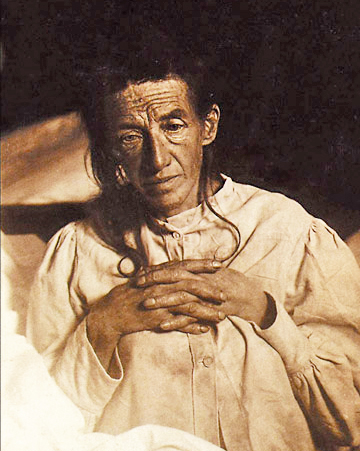
In Belgium, as in many high-income countries, dementia has emerged as a leading cause of death, particularly among older women. Several factors have driven the increase in reported dementia cases, including updates to medical classifications, greater awareness among healthcare professionals, and the aging of the population.
By the early 21st century, dementia was often recorded as the main cause of death rather than as a contributing condition. This change reflects not only a real shift in public health but also evolving practices to end-of-life care and how causes of death are documented.
A brief history
Awareness of memory problems in old age stretches back to ancient Greece. Thinkers like Pythagoras compared old age to childhood, as they observed a decline in intellectual capabilities in older people. Solon warned that aging could affect good judgement. Ancient physicians, including Hippocrates, attributed these changes to bodily imbalances, such as having too much “black bile”.
By the 1600s, doctors started to associate ageing-related changes in the brain with cognitive decline and behaviour. The term “amentia senilis” was used to describe memory loss in older adults.
By the late 1800s, researchers began to study the brain in more detail (Figure 2). Dementia was linked to brain shrinkage, and forms of dementia caused by vascular issues were described. In 1838, Jean Esquirol separated dementia caused by aging from intellectual disabilities that started at birth. But not everyone agreed—Belgian records still grouped them together as late as 1869
In the early 1900s, Alois Alzheimer identified the plaques and tangles now synonymous with Alzheimer’s disease. The condition was officially named “Alzheimer’s disease” in 1910. For decades, it was considered rare until the 1970s, when it became recognized as the leading cause of dementia in older adults.
Today, scientists have developed new ways to detect and treat Alzheimer’s, including tools that look at brain changes and drugs to help slow down the disease. Still, dementia remains incurable, with many unanswered questions about its causes and treatment.
Figure 2: Study of a brain, 1896

Dementia mortality over time
In 19th-century Belgium, dementia was rare and in the cause of death registration not clearly separated from other mental conditions (Figure 3). Doctors followed older ideas, such as those of the 17th century English doctor Thomas Willis, who grouped different kinds of “foolishness” together and linked them to problems in the brain caused by ageing, illness, or injury. Because of this, official records in Belgium combined dementia with “idiocy.” In 1869, the Belgian Ministry of the Interior reported 286 cases of death by “dementia and idiocy”.
More recently, dementia has become an increasingly common cause of death. Figure 4 shows how in the early 1970s, dementia accounted for less than 1% of all deaths. From then on, the number has been rising steadily.
Figure 3: Deaths from 'Dementia and Idiocy' were grouped together in Belgian cause of death statistics

Figure 4: Percentage of dementia deaths in Belgium, 1954-2020
Source: STATBEL; calculations by the author.
By 2019, dementia is responsible for approximately 9% of all deaths. The slight decline in 2020 likely reflects the consequences of the COVID-19 pandemic, which may have disrupted diagnosis and reporting practices or led individuals to die from COVID-19 instead.
In the 1970’s, less then 1% of men and women died of dementia. Over the following decades dementia claimed ever more victims rising to 4% of all male mortality and 9% of female mortality by 2019. Interestingly, women have always died more of dementia then men. The growing number of people dying of the disease highlights this enduring gender imbalance, even as life expectancy has become more equal.
Sex differences in dementia development are often explained by different factors. First, women tend to live longer than men, making their chances of getting dementia bigger. Second, women used to have fewer years of schooling, education being a protective factor for developing the disease. Lastly, women lose protective hormones like oestrogen after menopause, which may have protective effects on the brain. The loss of these hormones could make women more vulnerable to developing dementia later in life.
Dementia in Belgium through space
How dementia mortality is distributed across Belgium has changed a lot over time. The maps in figure 5 show the evolution of dementia from 1970 to 2019. We see a strong increase in the number of deaths. In 1970 and 1990, most dementia deaths occurred in Flanders. In 2000 and 2010, the numbers were more evenly spread across the country. By 2018, however, Flanders again showed higher dementia mortality than the rest of Belgium, which can be clearly seen on the map.
Environmental, social, and administrative differences may help explain why dementia death rates are higher in Flanders. First, people in Flanders tend to live longer than in other regions, and dementia is more common at older ages. This means that regions with longer life expectancy are also more likely to see more deaths related to dementia.
Other factors may also contribute. Flanders is more densely populated, meaning more people live close together. Densely populated areas often have more traffic and industrial activity, which can lead to higher levels of air pollution. Increasing evidence suggests that long-term exposure to air pollution may affect brain health and increase the risk of developing dementia later in life. These pollutants can enter the bloodstream and may contribute to inflammation and damage in the brain over time.
Social and economic conditions may also play a role. For example, differences in types of work, income, or social support can influence people’s health across their lives and may affect the risk of dementia at older ages. Finally, there may also be differences in how deaths are recorded. Doctors in different places may not always record dementia in the same way on death certificates. These differences may partly reflect variations in medical training, including the universities where doctors studied, in reporting guidelines, or even language. As a result, some regions may seem to have more deaths from dementia simply because dementia is recorded more often as a cause of death, even when underlying health patterns are similar.
Figure 5: Dementia mortality rates by municipality, 1970-2018
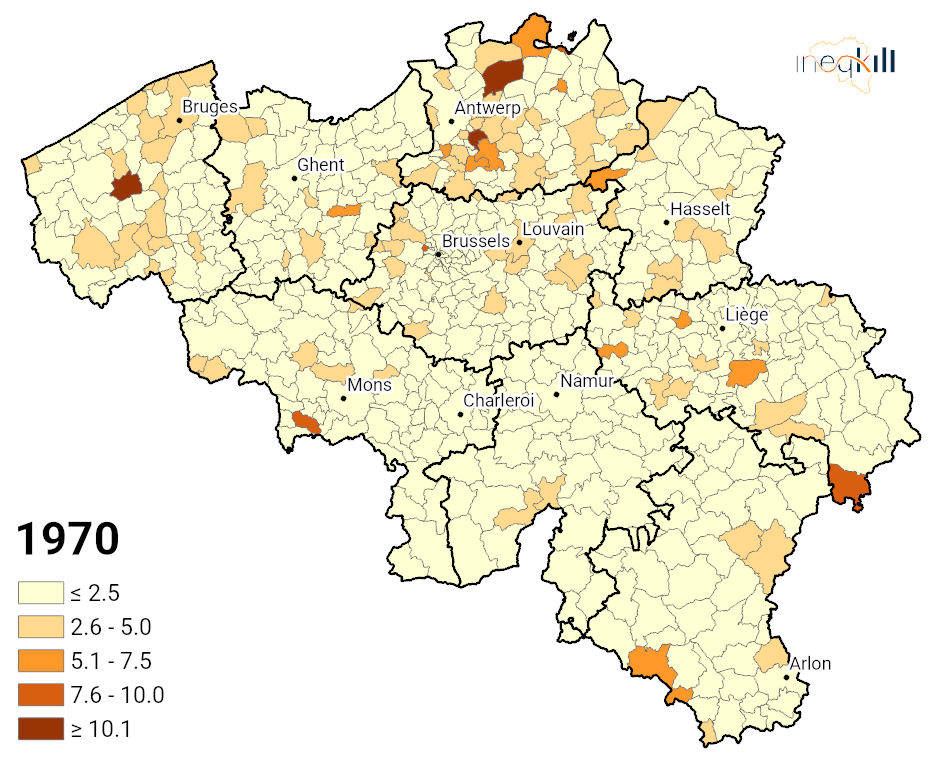
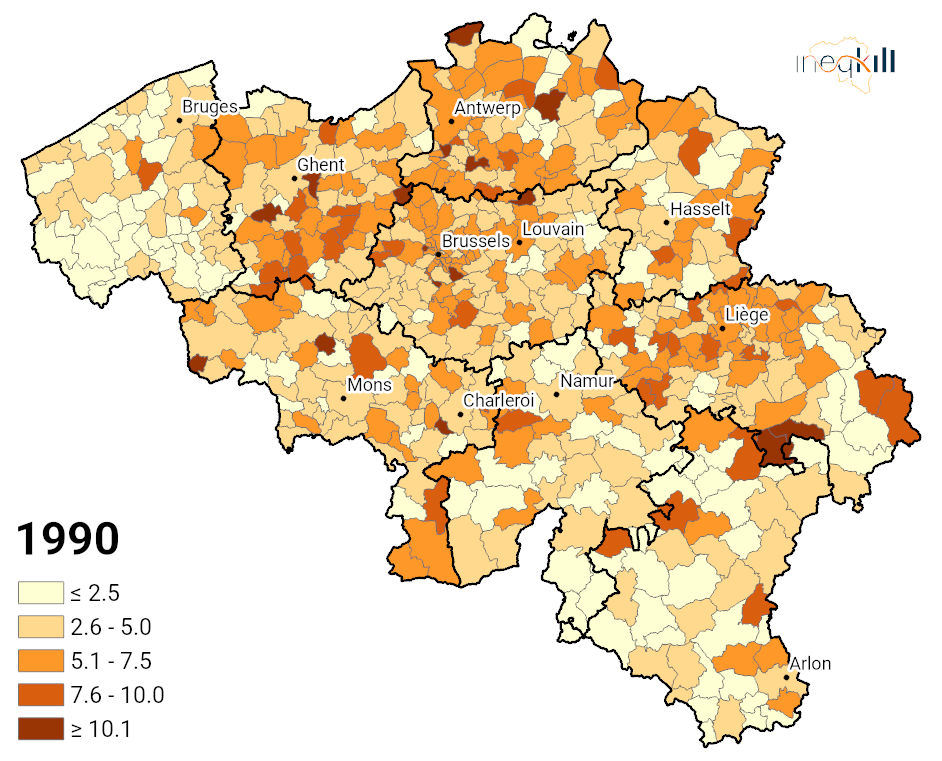
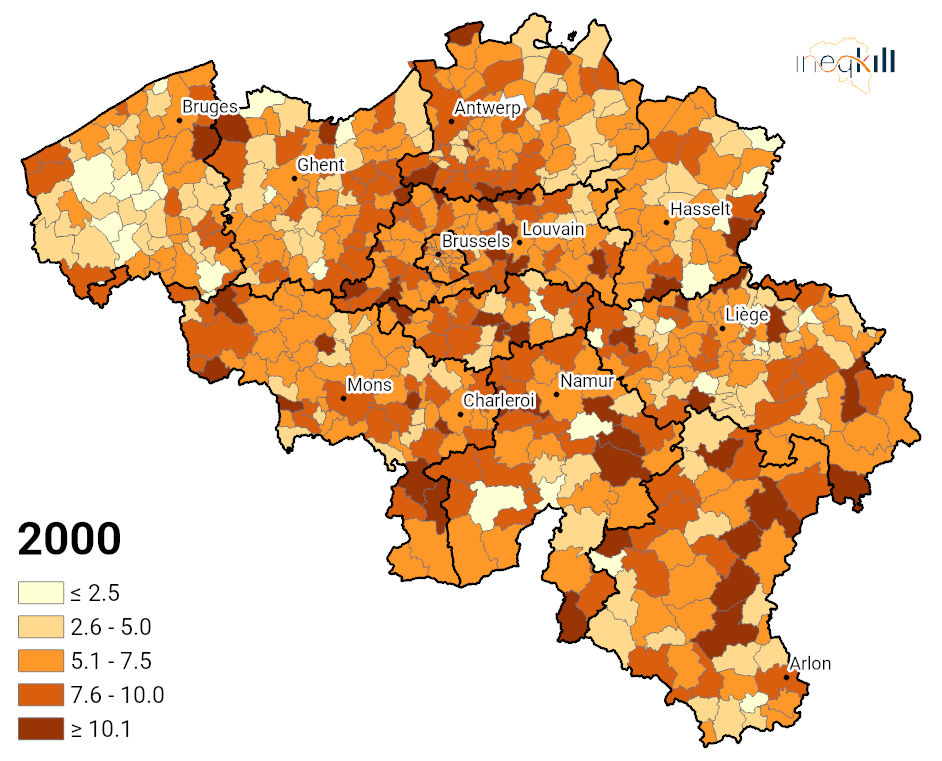
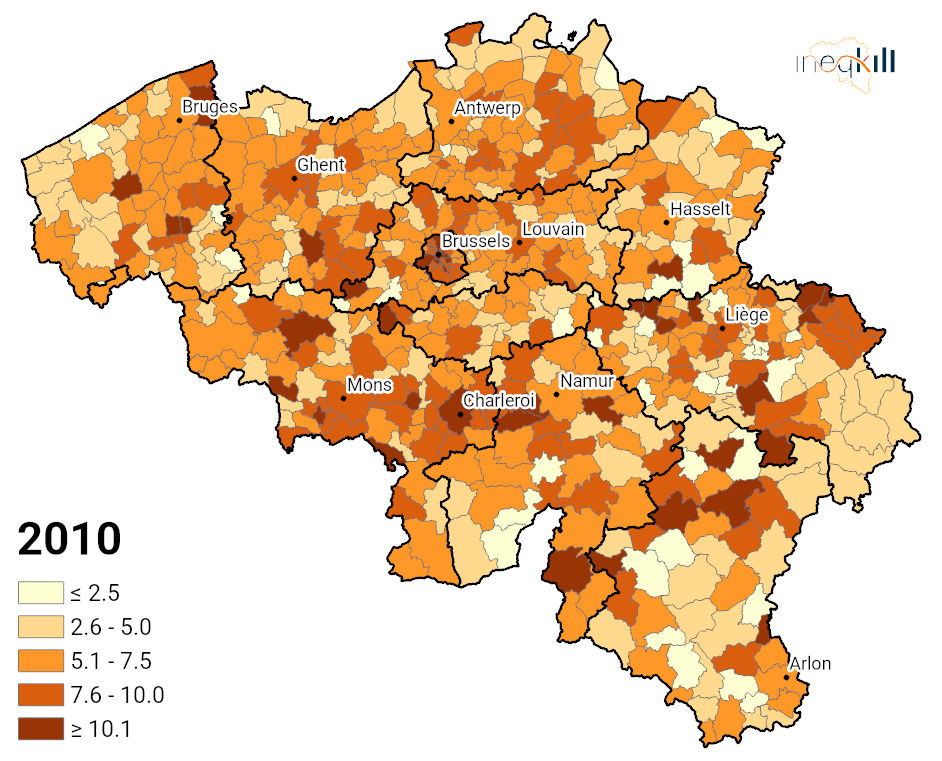
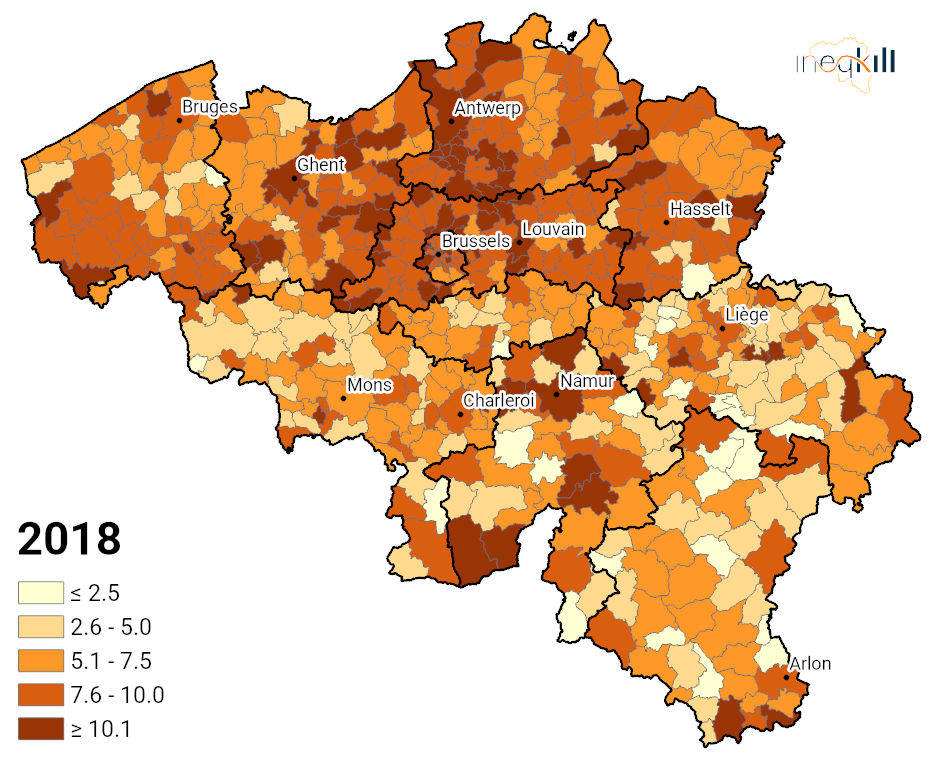
Age standardized total dementia mortality rates (per 10,000 population aged ≥ 45 years), 1970, 1990, 2000, 2010, and 2018. Source: data STATBEL; calculations by the author.
Inequality in dementia mortality?
Figure 6: Differences in dementia mortality by education level among older adults in Belgium, 2011–2016
Source: STATBEL; calculations by the author.
Not everyone faces the same risk of dying with dementia. In Belgium, data from 2011 to 2016 show social inequalities among people aged 65 and older. Both education and income had a clear impact on the risk of dying from dementia.
Figure 6 shows dementia mortality by level of education for both men and women. Education is divided into three groups: low (no schooling or only primary school), mid (lower or upper secondary school), and high (any kind of higher education, such as college or university).
The figure shows that people with less education are more likely to die from dementia than those with higher levels of education. It also shows that women with low levels of education are especially likely to die from dementia.
Income also plays a role, but it affects men and women differently, as we see on Figure 7. For men, the pattern is simple: men with lower incomes are more likely to die from dementia. In general, the less money men have, the more likely they are to die from dementia. The only small exception is the very richest group, where deaths are slightly higher than in the middle-income group.
For women, the pattern is less clear. Women in the second income group have the highest number of deaths from dementia. But women in the richest group have the lowest number of deaths overall.
These findings show that social and economic differences affect not just how long people live, but also how they die, including their chances of dying with dementia.
Figure 7: Differences in dementia mortality by income level among older adults in Belgium, 2011–2016
Source: STATBEL; calculations by the author.
Our publications
- Dinneweth, J., & Gadeyne, S. (2024). Socioeconomic disparities in neurodegenerative disease mortality: a population-based study among Belgian men and women aged 65 or older. INQUIRY: The Journal of Health Care Organization, Provision, and Financing, 61. (https://doi.org/10.1177/00469580241237113).
- Dinneweth, J., & Gadeyne, S. (2024). Unravelling the evolution of neurodegenerative disease mortality: insights from 50 years of Belgian data. Space, Populations, Societies, 2023/3-2024/1. (https://doi.org/10.4000/12tpx).
- Dinneweth, J., & Gadeyne, S. (2025). Linking social and environmental indicators to neurodegenerative disease mortality in Belgian municipalities using spatial regression analysis. Brussel: Vrije Universiteit Brussel, BRISPO. (https://doi.org/10.5281/zenodo.14859170).
- Dinneweth, J., Van den Borre, L., & Gadeyne, S. (2026). Occupational class and dementia mortality: evidence from Belgian census-linked data. BMC Public Health, 26(1). (https://doi.org/10.1186/s12889-026-27207-5).
- Eggerickx, T., Sanderson, J.P., & Vandeschrick, C. (2020). Mortality in Belgium from nineteenth century to today: variations according to age, sex, and social and spatial contexts. Quetelet Journal, 8(2), 7-59.
Read more
- Livingston, G., et al. (2024). Dementia prevention, intervention, and care: 2024 report of the Lancet standing Commission. The Lancet, 404 (10452), 572-628.
- Berchtold, N.C., & Cotman, C.W. (1998). Evolution in the conceptualization of dementia and Alzheimer’s disease: Greco-Roman period to the 1960s. Neurobiology of aging, 19(3), 173-189.
- Grand, J., & Feldman, H. (2007). Historical concepts of Alzheimer’s disease and dementia. In Atlas of Alzheimer’s Disease (pp. 1-26). London: Informa Healthcare.
- Goedert, M., & Ghetti, B. (2007). Alois Alzheimer: his life and times. Brain pathology, 17(1), 57-62.
- Assal, F. (2019). History of dementia. Front Neurol Neurosci, 44, 118-126.
- Vatanabe, I.P., Manzine, P. R., & Cominetti, M.R. (2020). Historic concepts of dementia and Alzheimer’s disease: from ancient times to the present. Revue neurologique, 176(3), 140-147.
- Maheshwari, S., et al. (2024). Navigating the dementia landscape: biomarkers and emerging therapies. Ageing Research Reviews, 94. (https://doi.org/10.1016/j.arr.2024.102193).
Data sources
- Documents statistiques de la Belgique publiés par le Département de l’intérieur, 1869.
- STATBEL, Mortality Databases, 1969-2020.